Our Latests Pretexts for “Regime Change” : Venezuela and Iran

Donald Trump is the “King of Pretexts” in a country where 10 of our wars since 1900 have been justified with pretexts. Recently in Venezuela, the pretexts of “Democracy Concern” and “narco-terrorism” have worn thin, as President Trump nakedly displayed his actual motive — a desire to control Venezuela’s oil.

Pivoting to Iran, where sanctions, a falling Iranian currency, and infiltration, have led to large public protests. Trump has a history of selectively repeating the now cynical-sounding “Democracy Concern,” along with Iraq-style fears of nuclear WMD as a pretext for the actual motive — Israel’s long-standing desire for “regime change” (and a breakup) of Iran.

The White House uses the narrative of Iranian nuclear WMD to justify further military action against Iran, deliberately conflating the concept of nuclear “Breakout”, which involves the production of sufficient nuclear fuel to make a bomb, with “Weaponization” — the building of a deliverable bomb. One can analogize this distinction to the difference between having enough gasoline to fuel a roadtrip, to building the car that will carry out that trip. On June 17, Trump was asked about his assessment of Director of National Intelligence Tulsi Gabbard’s report that Iran was not building a nuclear weapon.  Trump replied: I don’t care what she said. I think they were very close to having one disavowing both his DNI and the Intelligence Committee whose view she represents, and favoring Israeli “Intelligence” over his own US Intelligence Community’s assessment.

A History of Phony Justifications

They took the babies out of incubators, took the incubators and left the children to die on the cold floor.

Since 1900, U.S. leaders have misled the public into conflicts at least ten times. From the munitions hidden on the RMS Lusitania in 1915 to the fabricated “incubator babies” testimony that swayed the 1991 Gulf War vote, and the non-existent WMDs in 2003, propaganda has consistently been used to sell unpopular or unsuccessful wars.  (Read longer article)

Currently, hawks in the U.S. and Israel are pushing a narrative that would achieve a “sequel” to the Iraq WMD war, completing the aspirations of neoconservatives’ to overthrow seven mid-east countries, albeit not in the originally projected 5-year timeframe. While the public is told the goal in Iran is “denuclearization”  or “democracy”, the actual objective is and has been Iranian regime change.

The Nuclear Claim vs. Reality

Following the 12-Day War in June 2025’s “Operation Midnight Hammer,” White House Secretary Karoline Leavitt claimed that Iran would only take a couple of weeks to complete the production of that weapon However, the fact that this was actually an Israeli assessment of the Iranian nuclear program, which the American Intelligence Community disagreed with, wasn’t widely known. U.S. Intelligence (the IC) maintained that while “Breakout” (accumulating enough fuel) could take weeks, “Weaponization” (engineering a deliverable warhead) would take six months to a year.  Moreover the American Intelligence Community has consistently maintained that Iran is not building a nuclear weapon and Supreme Leader Khamenei has not authorized the nuclear weapons program that he suspended in 2003.

(I’ve developed a citation app that enables readers to inspect citations to view quote context.  Feel free to dig into the cited quotes!)

CIA Director William Burns and DNI Tulsi Gabbard both testified in early 2025 that the CIA doesn’t see any evidence that Iran’s Supreme Leader [Ali Khamenei] has made a decision to move to weaponize, and has not lifted the prohibition (fatwa) on nuclear weapons which would be needed before nuclear weaponization would be allowed to proceed.  Despite the dissenting American assessment, which has the benefit of not being biased by the same conflicts of interests as the Israeli assessment, the media often fails to differentiate between Israeli claims and actual U.S. intelligence, creating a manipulative narrative that ignores the American IC’s dissent.

The Goal of Regime Change

Evidence from the 12-Day War confirms that the June mission went beyond bombing nuclear sites at Fordow and Natanz. Israel conducted cyberattacks to hijack Iranian State TV, replacing broadcasts with protest imagery designed to spark a revolution. Israeli think tanks, such as the INSS, have since admitted that regime change was the ultimate goal:

it is clear that some of Israel’s actions, especially during the second week of the war, were intended to undermine the regime’s foundations and encourage the Iranian public to take to the streets and resume their popular protest movement. Moreover, these actions presumably would have continued and perhaps even intensified had the war not ended in a ceasefire after 12 days

Israeli (2)Kuwaiti, and French sources reported that the satellite feed for Iranian state-run television was disrupted on ~ June 19 and replaced by an alternate video calling for street protests against the Iranian government. On State TV the satellite feed was replaced with video showing women cutting their hair, a symbolic Iranian practice performed in times of protest or mourning. (video)

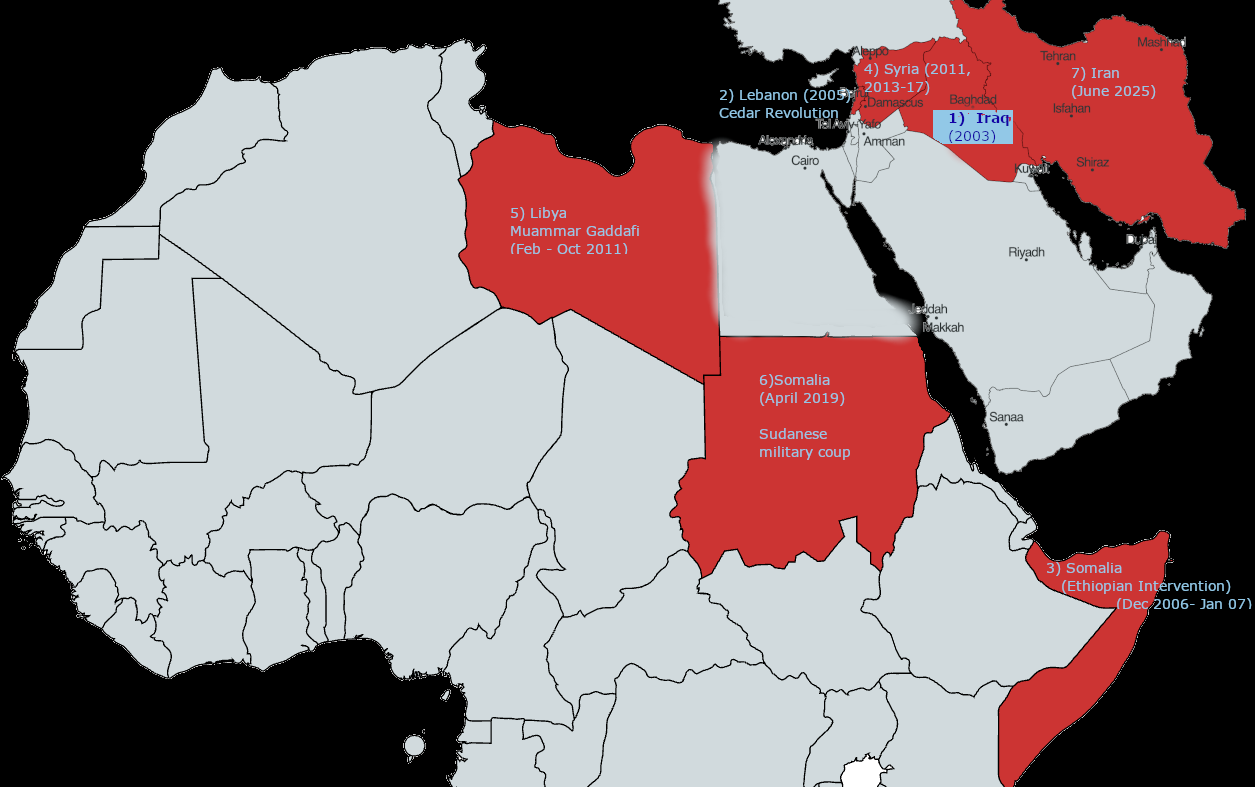
This regime-change strategy is consistent with the 2007 revelation by General Wesley Clark that he was shown a memo that describes how we’re going to take out seven countries in 5 years, starting with Iraq and then Syria, Lebanon, Libya, Somalia, Sudan, and finishing off Iran.

7 Countries in 5 years: intervention:

  1. Iraq (March 2003, regime change)
  2. Syria (Aug 18, 2011) (Timber Sycamore 2013-2017)
  3. Lebanon (Cedar Revolution 2005)
  4. Libya (Feb – Oct 2011)
  5. Somalia (Ethiopian intervention Dec 2006 – Jan 2007)
  6. Sudan (April 2019 Sudanese military coup)
  7. Iran (2025 anti-nuclear strike & regime change attempt)

Iranian Missile Deterrence?

In theory, the risk of a regional or world war should be precluded by Iran’s large conventional missile deterrent, which Iran demonstrated is capable of breaching Israel’s Iron Dome.  Perhaps Israel has the ability to disable Iran’s thousands of missiles electronically, or perhaps Israel believes it has a way to overthrow the Iranian government without provoking Iranian retaliation using missiles.

If full war breaks out with Iran, it has the potential to lead to a decade-long conflict far more catastrophic than Iraq. Potential consequences include a blockade of the Strait of Hormuz, leading to $7/gallon gasoline, and even the “Samson Option“—a nuclear murder-suicide threatened by Israel in the event they would be defeated.

Let us hope that operational success in Venezuela has not emboldened a president who campaigned on “peace” to risk regional or world war to satisfy a “regime change” that his Presidential campaign promised his voters he had forsworn.


by Tim Langeman  | Homepage | SubstackYouTube

If you’d like to learn more about the contextual citations used in this article, send me an email at tim@openpolitics.com.  I hope to gather a list of potential beta-testers and pitch the app to Substack.

Protecting Democracy from Corporate Money While Allowing Transparent Corporate Speech

A Proposal That Honors Justice Anthony Kennedy’s Vision of Corporate “Information”

Throughout American history, rights have typically expanded rather than contracted. However, the unique challenges facing American democracy today may warrant rethinking certain rights afforded to large corporations. Mitt Romney famously remarked that Corporations are people, and while that concept has become embedded in U.S. law, it has arguably gone too far. Expansions in corporate “personhood” and “speech” (i.e., political spending) have disproportionately elevated corporate influence in politics, often at the expense of the American electorate.

The rise in corporate political spending has suppressed the voice of average voters and contributed to their sense of disillusionment. In 2014, Studies by political scientists Martin Gilens1 and Benjamin I. Page 2 revealed the preferences of the average American appear to have only a minuscule, near-zero, statistically non-significant impact upon public policy. This imbalance distorts democratic governance, where elected officials increasingly prioritize the interests of the wealthy and corporations over those of the median voter.

Anthony Kennedy, Associate Justice of the Supreme Court of the United States (Wikipedia)

The U.S. Supreme Court’s 2010 Citizens United ruling defended corporate political expenditures as “speech,” with Justice Anthony Kennedy opposing restrictions on corporate “speech,” saying Corporations have lots of knowledge about environment, transportation issues, and you are silencing them during the election. But is there a way to balance this principle of free speech with the need to protect the electoral system from undue corporate financial dominance?

Idealized Corporate Speech vs Reality

Justice Kennedy’s vision of corporate speech reflects an idealized view that resembles classical economic theories, where all actors possess “perfect information” and make rational choices. Kennedy assumes that corporations share useful, specialized knowledge with the public in good faith. However, corporate behavior in politics often prioritizes profit over good information and transparency.

Take Exxon for example:

Exxon was aware of climate change, as early as 1977, 11 years before it became a public issue, according to a recent investigation from InsideClimate News. This knowledge did not prevent the company (now ExxonMobil and the world’s largest oil and gas company) from spending decades refusing to publicly acknowledge climate change and even promoting climate misinformation—an approach many have likened to the lies spread by the tobacco industry regarding the health risks of smoking.

Just as light can be treated as both a wave and a particle, under current law, speech can be treated as both “communication” and “money.”   (fact check). Corporations prefer to use the “money” aspect to “donate to”/bribe elected officials rather than engage in accountable public speech. Instead of educating voters through public ads or informative campaigns, large corporations contribute millions to misinformation campaigns and practice divide and rule tactics by hiring consultants to amplify unrelated wedge-issue campaigns on issues like Critical Race Theory or earlier Anti-Gay Marriage campaigns that distract the electorate from the real corporate interests. (fact check)

Proposal: Permit Corporate “Communication”, Forbid “Money” Speech

To reconcile the value of corporate knowledge with the need to limit financial influence, I propose a strict reform: allow large corporations to engage in public communication directly relevant to their area of expertise, but forbid all forms of “money speech”—i.e., significant financial contributions aimed at political influence.

Rex Tillerson
Rex Tillerson, former Exxon mobile CEO,  official Secretary of State portrait (Wikipedia)

Under this model, large corporations would still be allowed to share information directly relevant to their industry or expertise but would be required to do so transparently. For instance, if ExxonMobil wanted to discuss climate policy publicly, its CEO would need to explicitly approve the message—for example, by stating, “I’m Rex Tillerson, CEO of ExxonMobil, and I approved this message.” This ensures voters know who is behind the message and why, preserving transparency and accountability.

Barring “Money” Speech Entirely

Large corporations, however, would be strictly prohibited from making any direct or indirect financial contributions to candidates, political action committees, or third-party groups. The ban on financial influence would prevent corporations from swaying elections through money while still allowing them a voice in public discourse—albeit one fully transparent and accountable to voters. Small and medium-sized businesses such as Scalia’s local hairdresser the local auto repair shop the the local uh new car dealer may retain flexibility to combine their efforts in small alliances whose individual disclosure may involve less up-front visibility due to the large number of participants, but large corporations that possess the power to substantially alter political outcomes would have disclosure requirements similar to political candidates.

The “Speaking” Filibuster: Make them Speak

The “speaking filibuster” reform idea offers a useful analogy. In the 1950s, when Senator Strom Thurman wanted to filibuster the 1957 civil rights act, he had to actually take the floor of the Senate and speak continuously in opposition to the bill.  Today, however, senators can simply declare a filibuster without speaking or making their filibuster public, which often obstructs legislation in a way that is hidden from public scrutiny.

Segregationist Strom Truman filibustered for a record 24 hours against the 1957 Civil Rights legislation, but was not able to stop its passage. Today you can filibuster by merely saying you want to “filibuster”, without actually having to hold the floor. There are proposals to revert to a ‘“spoken filibuster.” (Wikipedia)

Similarly, my proposal would end the practice of large corporations’ bad faith claims to want to educate the public (share information) when in fact they prefer to employ money and front groups to sabotage accountable governance. Just as the speaking filibuster holds senators accountable for obstruction, this reform would ensure that corporate influence in politics remains visible, transparent, and limited to public-facing speech.

Restoring Balance in Democracy

In summary, this proposal advocates a two-tiered model of corporate engagement in politics. Large corporations would be permitted to share public information on issues relevant to their expertise, but they would be barred from using financial influence to fund non-transparent speech or donate money to candidates. This approach respects corporate rights to share knowledge while safeguarding the electoral system from the disproportionate influence of money.

Corporate Media has Incentive to Suppress the Issue

One thing not addressed by this proposal, but standing in the way of its passage, is the conflict of interest held by Corporate media.  Media companies, especially in swing states like Pennsylvania, where I live, receive substantial revenue from political advertising. This financial incentive may discourage them from covering campaign finance reform, even though polling data shows broad public support for such measures.  (fact check)

Though campaign finance reform remains an uphill battle,  we cannot resign ourselves to the unchecked corporate influence enabled by errant Supreme Court precedent. Though corporate lawyers and political operatives may fight back initial challenges, we must channel our inevitable short-term defeats into progressive building blocks of change.  Only by ensuring that corporations engage transparently in speech while limiting their financial influence, can we restore the power of the electorate and faith in government as a representative of the people.


  1. formerly a professor at Princeton, now UCLA

  2. Professor at Northwestern

US General Says the Quiet Part Out Loud – Why the US Cares about South America?

General Laura Richardson
Jan 19, 2023: General Laura Richardson speaks to The Atlantic Council (Think Tank)

Why Should you Care? Oil, Gold, Copper, Lithium, Water

Listening to an old keynote speech by Southern Command General Laura Richardson to The Atlantic Council, I got  the sense that she was unintentionally letting the viewer in on how America elites think about extracting resources from “partners” operating under the purview of the Southern Command region (our “back yard”).

US Military: 6 World Regions
Map: US Military: Unified combatant command

Why South America matters:

  • oil
  • gold
  • copper
  • lithium triangle
  • rare earth elements
  • fresh water
  • fresh air (Amazon)

Regions:

  • Northern Command
  • Southern Command
  • Africa Command
  • European Command
  • Central Comman
  • Indo-Pacific Command


(click on the quotes below to view video and its context)

1) Drop the pretense: Why South American matters?

Why this region matters: with all of it’s rich resources and rare earth elements you’ve got the lithium triangle, which is needed for technology today. 60 percent of the world’s lithium is in the lithium triangle — Argentina, Bolivia, Chile. You just have the largest oil reserves , light sweet crew discovered off of Guyana over a year ago. You have Venezuela’s resources, as well with with oil, uh copper, gold. China gets 30, 36 percent of its food source from this region. We have the Amazon lungs of the world. We have the 31 of the world’s fresh water in this region too. I mean it’s just off the charts!

2) US should build more infrastructure in Southern Command:

American critics of the MICIMATT often comment about inadequate US infrastructure.  Richardson talked about investing in infrastructure in the Southern Command Region to counter China (the PRC ).

You’re actually talking about the U.S investing more in in critical infrastructure talking about making economic Investments right in the region.  Absolutely, absolutely, so if I’m the uh as the the uh, not a lot of visitors  maybe or folks that are going into the country or the opportunity that I have while I’m there that I get to see this meet with leaders talk to them about their challenges

3) The Military acts as “Muscle” for US Corporations. It should act as Lobbyist too.

I go back to the equipment we see now all of a sudden you know looking elsewhere other than U.S equipment who has a better finance package oh but minister you’ve got to look get the equipment you’ve got to look at what you get. You can’t compare well. I need to know, you know, what about the financing that’s more important to me right now. But Russia can’t be provide. I can’t have the ability to provide many of these countries with with resupply or new weapons. I mean they’re struggling to supply themselves in many cases for Ukraine so is that presenting an opportunity for maybe the U.S to slide in? Absolutely and we’re taking advantage of that I’d like to say so we are working with those countries that have the Russian equipment to either donated or or switch it out for United States

More Information:

There were other topics covered in the speech, such as suppression of narcotics, but I thought coverage of the above three topics was illuminating.

You can view the whole speech on YouTube.


More by Me:

  1. CiteIt App: expands Contextual Citations – aims to build reader trust in writers which show the context of their quotations.
  2. Monster Mash: Military Industrial Complex Song, set to the classic Monster Mash tune.